An opinion piece I wrote on the cultural politics of mindfulness has been published:
http://www.abc.net.au/religion/articles/2015/03/05/4191695.htm

An opinion piece I wrote on the cultural politics of mindfulness has been published:
http://www.abc.net.au/religion/articles/2015/03/05/4191695.htm
This article ‘The white science of meditation’ connects nicely with the previous post.
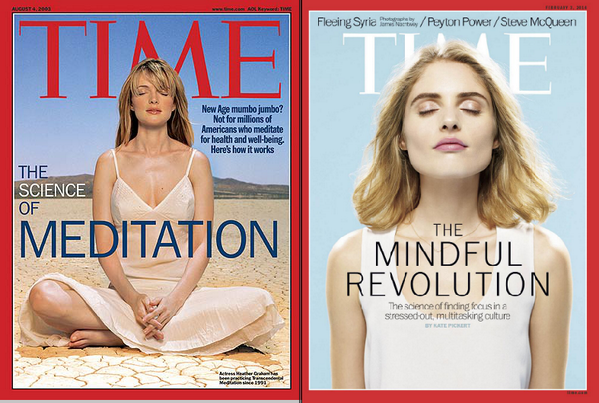
This is why I would insist on giving space, extending hospitality to religious interpretations of the practice in public discussions. But not because, as some people have taken umbrage to, I wish to deny the potential benefits offered by scientific enquiry, or keep the practice inaccessible by clouding it in some air of mysticism, or reify the concept of ‘religion’, which, after all, is a Euro-Christian invention that cannot be directly translated to Asian Dharma traditions. But the fact is ‘religion’ has been imposed by the West upon the world, such that it is at once the framework by which non-Western, non-white heritages are able to seek legitimacy in public debates and also the means by which they are denigrated, demonised, excluded, and marginalised. I think one uncomfortable truth that the contemporary world struggles to face up to is the extent to which ‘religion/secular’ has less to do with ‘beliefs’ than the maintenance of racial or ethnic prejudice and superiority.

The following is from this wonderful article, ‘Mindfulness’ “truthiness” problem: Sam Harris, science and the truth about Buddhist tradition’
Our concerns have nothing to do with complaints that Buddhism is being diluted or whether the mindfulness movement is an authentic and accurate representation of traditional Buddhist teachings, although those who venture to raise critical questions are often immediately pigeonholed as out-of-touch Buddhist purists. To be clear, we know of no one opposed to meditation being employed for reducing human suffering of any kind. But we do take issue with the troublesome rhetoric that the Buddhist tradition amounts to nothing more than an outdated set of cultural accretions. Author Sam Harris exemplifies this in his essay “Killing the Buddha,” when he characterizes the Buddhist religious tradition as an “accidental strand” of history and tells those in the mindfulness movement that they “no longer need to be in the religion business.” Dan Harris, co-anchor of ABC’s “Nightline” and “Good Morning America” and the author of the best-selling book “10% Happier,” decries “meditation’s massive PR problem,” code for shedding any associations with anything that smacks of Buddhism. This kind of deprecatory, at times hostile characterization of the Buddhist tradition betrays a terrible lack of understanding of what it means to engage meaningfully with a religious tradition, and a naïve belief in the unassailable authority of science as the sole arbiter of truth, meaning and value.
‘In effect, indigenous wisdom traditions of the non-western world are separated from their western counterparts at customs and forced to travel down the red channel. This is because, unlike western philosophies, they are believed to have “something to declare” – namely, their “religious,” dogmatic or “tradition-bound” features which mark them out as culturally particular rather than universal. Before being allowed to enter the public space of western intellectual discourse, such systems of thought must either give up much of their foreign goods (that is, render themselves amenable to assimilation according to western intellectual paradigms), or enter as an object of rather than as a subject engaged in debate.’ ~ King, Richard 2009, ‘Philosophy of Religion as Border Control: Globalization and the Decolonization of the “Love of Wisdom” (philosophia)’, in P Bilimoria and A Irvine (eds.), Postcolonial Philosophy of Religion, Springer, London, p. 45.
 spacetimemattering